
When AI can make anything,
what should humans discern?
Identity design through logos, rebranding, and vision diagrams
When generative AI makes design easy to mass-produce, what truly shapes a brand? This article explains Kachinode's design process: working with AI as a co-creation partner while relying on human interpretation and decision-making to discern what makes an organization itself, and integrating it into one coherent identity.
With the rapid evolution of generative AI, logo drafts, copy, websites, key visuals, and design systems can be produced faster and in far greater volume than before. First drafts arrive sooner, options multiply, and the cost of trial and error keeps falling. But an organization's identity never emerges from simply lining up AI output.
What matters most in identity design in the AI era is not the power to give form, but the power to discern — from countless options — the essence of what makes the organization itself, and to edit it into consistent words and shapes.
Through startup logo design, vision diagrams for open innovation, and our own rebranding, Kachinode has built a distinct process for converting unseen value into an identity that can be told.
What we support, and where.
Identity & concept design
- Organizing the core value of organizations, services, and projects
- Putting change and its context into words
- Brand statement development
AI-assisted creative development
- Logo refinement starting from AI output
- Precise shape cleanup
- Color system & typography design
Visualizing context (vision diagrams)
- Concept diagrams that capture multiple stakeholders’ intent
- Visuals for internal alignment (inner branding)
Brand deployment across touchpoints
- Website & landing-page design and production
- UI & component design
- Design system development
- Proposal decks & identity guidelines
The more ways there are to make, the easier identity blurs
With AI, producing dozens of initial logo directions, generating multiple lines of copy, and comparing UI and design-system directions in a short time has become remarkably efficient. But as output and options explode, a different layer of difficulty comes into focus.
AI output is a bundle of probabilities — a field of possibilities. Selecting from it the singular expression that can stand as an organization's identity, polishing it, and giving it its own meaning requires a human process of interpretation and editing.
From a flood of plausible expressions to a story that lasts
Branding and identity design in the AI era run into a new set of problems:
Too many options, no criteria
Dozens of directions can be generated — but the axis for selecting and judging them blurs.
Thinning meaning
A “cool,” “current,” “tidy” visual takes a moment to make — but it may express nothing of the organization’s history, context, or particular value.
Breakdown at deployment
Beautiful as a single deliverable, but it fails when scaled across the web, documents, business cards, and real product screens.
Words and visuals split apart
Generated piece by piece, the copy, logo, and UI stop looking like one thing — never adding up to a coherent story or system.
The essential question is not whether to use AI. It is whether, from the options AI has expanded, you can discern what is true against the organization's context — and integrate it into an identity that keeps working in society.
Five approaches that move between AI output and human judgment
Kachinode builds AI deep into the process as a leading-edge partner — while pursuing, to the end, the precision of human interpretation and editing where the identity finally lands.
Refine AI output to the precision a brand requires
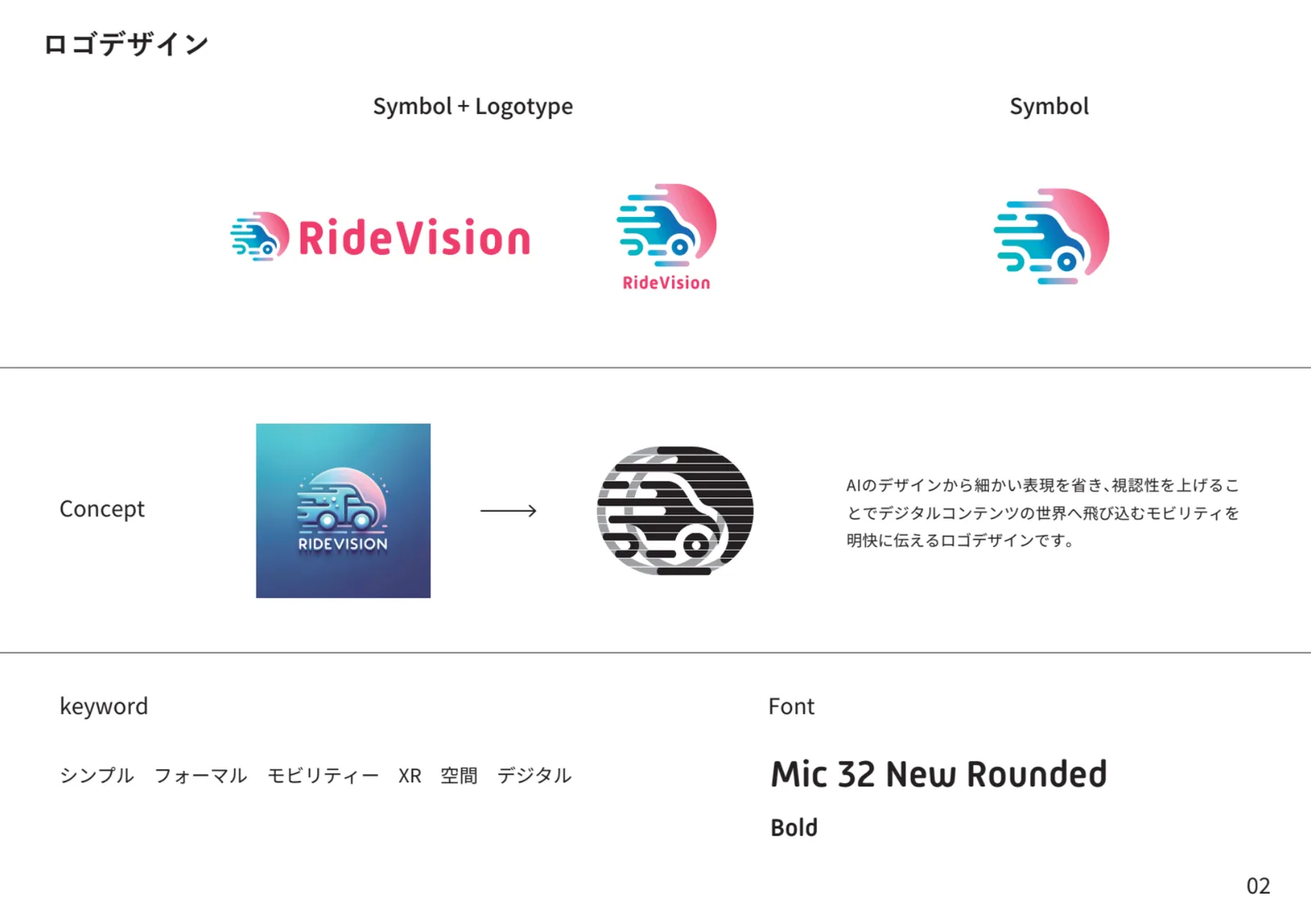
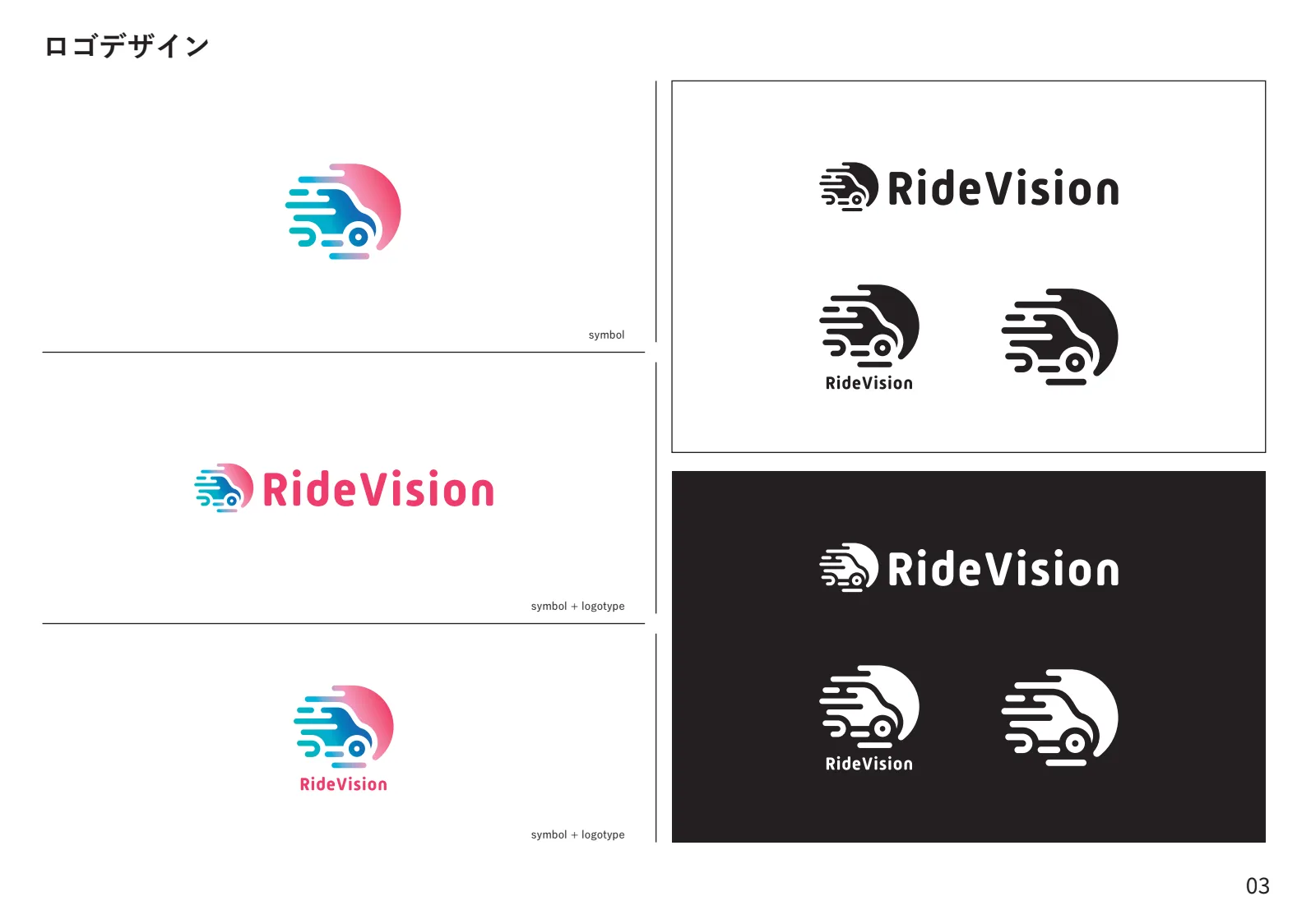
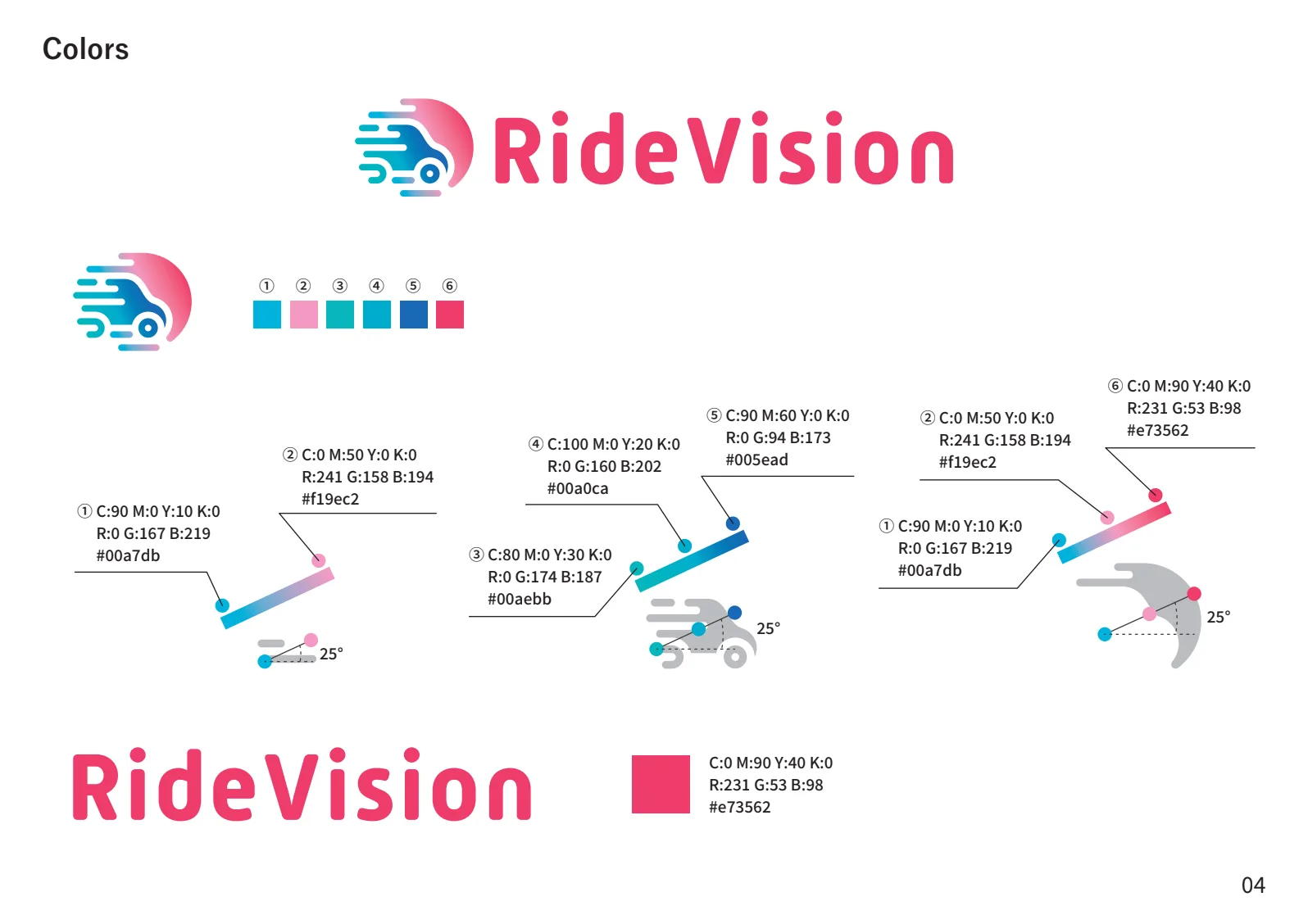
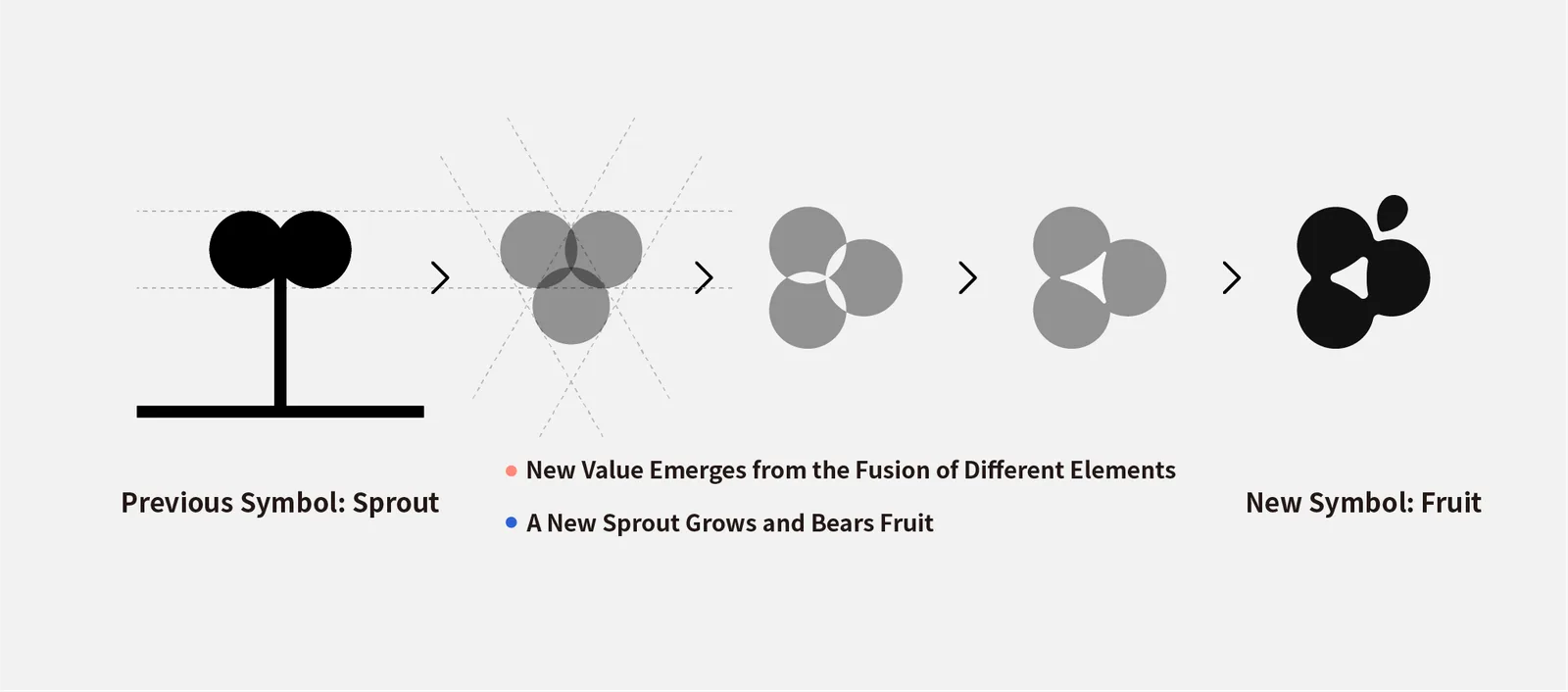
For a startup’s service logo, we took an approach that starts from AI-generated prototypes. AI can propose diverse directions in very little time — but as-is, its output falls short on fine-grained precision, legibility, and deployability across media. We treated the AI output as raw material full of possibility: mathematically cleaning up the geometry and redesigning the color system by hand. Stripped of noise, the mark now stands up to harsh conditions — small sizes, monochrome print — as the brand’s symbol.
Read the complex context AI cannot see, and turn it into a vision diagram
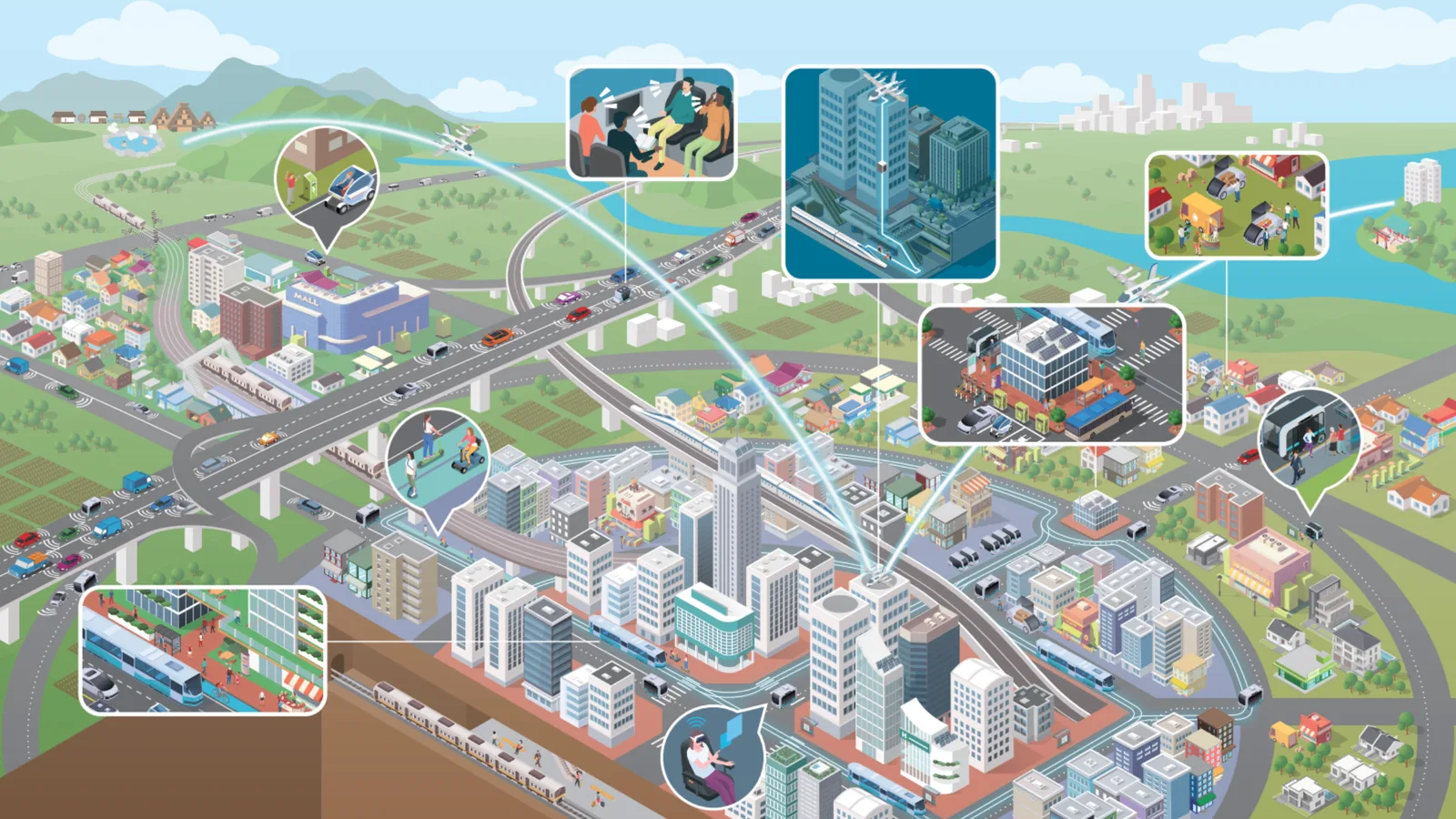
For an open-innovation project with many players, we deliberately set AI generation aside and focused on drawing out context through human dialogue, producing an internal vision diagram. We rewove the words of business units, executives, and external partners into a single visualization of the project’s goals and flow of value. Organizing the raw relationships and future an organization holds — which no AI has learned — into a common language is exactly the kind of human identity work whose value rises in the AI era.
Redefine our own change and future in dialogue with AI
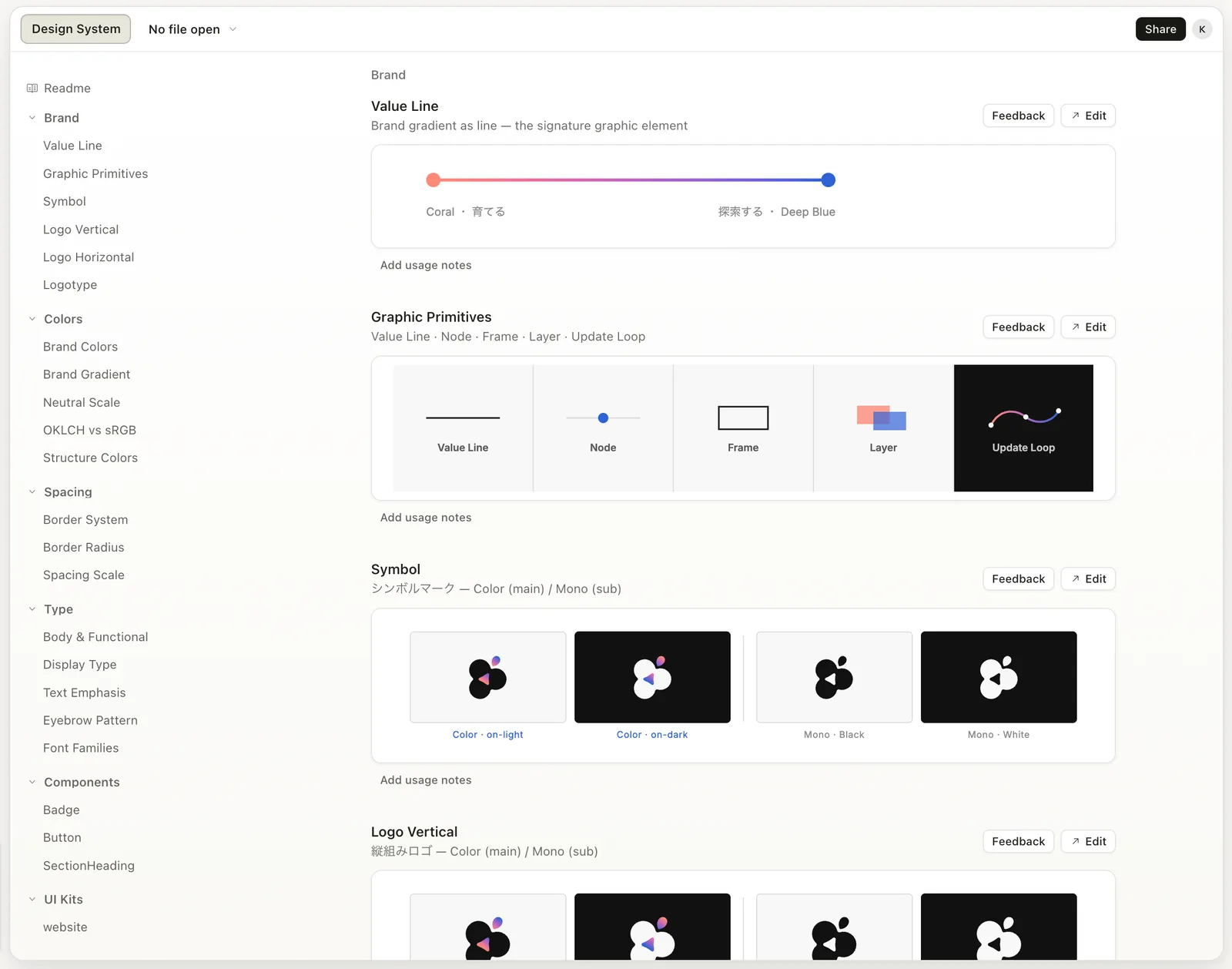
For Kachinode’s own rebranding, we brought AI in as a full sparring partner for thinking. To redefine our position — expanded from the founding “design company that gives value form” to “a company that designs growth spirals for startup ecosystems and new businesses” — we used AI to review our history, re-articulate our value, and explore the UI design system. Concretely, Claude Design and similar tools generated landing-page components and color-gradient expressions in fast parallel, dramatically accelerating the compare-and-decide cycle.
Integrate logo, diagrams, visuals, and web into one story
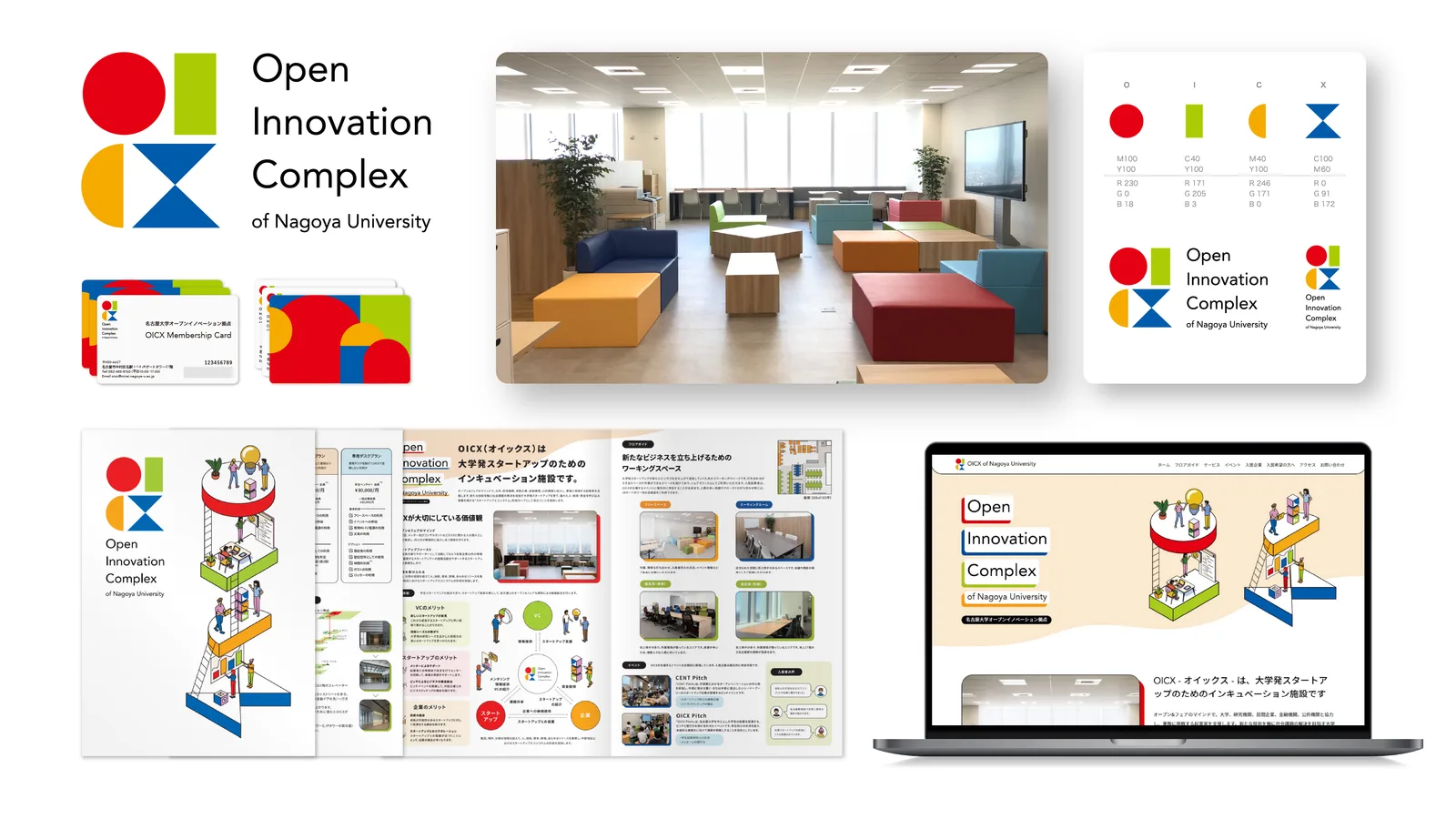
An organization’s identity is never complete in a single deliverable. The logo is the mark of memory; the vision diagram, the structure of thought; the key visual, the intuitive atmosphere; the website and documents, the interface that carries them to society. Precisely because AI makes individual parts easy to produce, Kachinode designs them not as separate deliverables but as one coherent identity system that tells the organization’s value.
Decide what not to choose, and build the axis for decisions
AI expands creative trial without limit — but the final decisions are human ones: what to lead with, what to leave unsaid, which direction to drop and which to commit to. What we value most in the design process is evaluating the possibilities AI has opened together with the client, sensing what fits and what doesn’t, and finally giving meaning to the resolve of “this is the one.” That act of discernment itself becomes the foundation of a strong identity.
What we have made in identity design
Creative work Kachinode has implemented by combining AI with human judgment.
- Organizing the value of organizations, services, and projects / articulating the context of change
- Brand concept / statement development
- Restructuring the brand story that connects past and future
- Service logo design / geometry cleanup / color systems
- Key visuals / concept visuals
- Vision & concept diagrams that align multiple departments
- Responsive websites / brand landing pages
- Evaluating, selecting, and precisely refining AI-generated prototypes
- Rapid UI & component exploration with Claude Design and others
- Next-generation design systems (design tokens)
Identity becomes the north star of daily decisions and communication
Our goal is not surface polish. When identity becomes clear, it generates lasting change inside the organization and the project:
Executives
Can explain where the organization stands and where it is heading — in words and visuals that do not waver.
Inside(team & partners)
The logo, vision diagram, and statement become a common language; everyone shares one story and moves on their own.
Outside(clients & partners)
People sense intuitively what the organization values and what future it is building — and trust it.
AI co-creation
AI becomes not a mere automation tool but a good companion that widens options and deepens human thought and judgment.
A finished logo or website is a beginning, not an end. Used and referenced daily — in sales, hiring, proposals, and project work — the identity starts to function as the organization's firm standard for judgment.
In the AI era, design lives not in making —
but in discerning
AI has decisively unlocked the speed and volume of making. Precisely because design is being democratized, what creates the decisive difference is no longer the power to make. "What should we choose? What do we keep, what do we change — and what do we deliberately leave unsaid?" The organization's identity lives inside that cool yet emotional process of judgment.
For Kachinode, design has never been about tidying surfaces. It is reading unseen value, giving it words, giving it form, and deploying it to the right touchpoints with society.
In an era where AI is the given, the human power to discern value and edit it into narrative shines. Turning unseen value into an identity that can be told — that is what we call Value Design.